It's easy to get sanctimonious about Bob Dylan winning the Nobel Prize for Literature. It's easy to enter the warm flow of his lyrics—so elastic and full of possibility that they have supported speeches of presidents, decisions of the Chief Justice of the United States Supreme Court, countless nervous breakdowns and romantic break-ups and what will likely be hundreds of articles in the next few days—and pull together something reverent and wise. It's easy to get cute and cynical too. This whole business of black-tie galas for the elite to honor themselves? It's a Rock and Roll Hall of Fame redux, but without the All-Star band and those endless guitar solos while Paul Shaffer frantically tries to reel everybody back to the chorus.
 The one thing that's not easy is not saying something. We do a lot of Dylan around here—thousands of words written, thousands of hours hearing the songs, plumbing the lyrics no less passionately and carefully than Aquinas or Maimonides plumbed the holy books. The inbox is overflowing with good wishes because of this obsession. Yet another wave of Dylan is upon us, like the first time he almost died, or the second time he almost died or the years he was reborn and then came back and then disappeared in plain sight while somehow not meeting the expectations of some while still others celebrated the mere fact of living in his lifetime.
When it comes to Dylan, we're obligated to ask what this Nobel Prize is all about. Part of the answer is found in what Bruce Springsteen once said about Bob Dylan—not the line about Dylan freeing our minds after Elvis freed our bodies or how Dylan proved that a rock and roll song could contain the whole world. All of this is true and no one knows better than Springsteen. The rock and roll revolution at its best meant emancipation and justice and hope as powerfully as any burst of cultural enlightenment and challenge we've touched. We're thinking about that other gem of a quote, the one where Springsteen says that Dylan is like the brother that you never had.
Now wait a minute, Bruce. You're the brotherly one, the guy posing in Barnes and Noble stores across the country with soccer moms in cardigans and starry-eyed divorced dads on the cusp of old age. You're the one who turns up in pizza joints in New Jersey and L.A. to share a beer with a random admirer. As rarely seen offstage as the Coo Coo bird on the Fourth of July, at best Dylan might be spotted in public in a hooded sweatshirt looking for Springsteens's childhood home in the rain or pretending to beg for change next to his tour bus.
Springsteen's comment on Dylan as your brother was cribbed from Dylan singing about Lenny Bruce, the ferocious comedic junkie prophet who died not long after Dylan first ruled the world:
They said that he was sick ’cause he didn’t play by the rules
He just showed the wise men of his day to be nothing more than fools
They stamped him and they labeled him like they do with pants and shirts
He fought a war on a battlefield where every victory hurts
Lenny Bruce was bad, he was the brother that you never had
These may not be Dylan's best lyrics, appearing on Shot of Love, an album that did not garner much enthusiasm in its day. But if you sit with these words for a while, Springsteen's praise for Dylan as the brother you never had might actually explain what the the Nobel Prize means for all of us who care about how the spirit of popular culture conjured by Dylan has seized the world. Joan Baez explains this spell best in an interview in Martin Scorsese's documentary of Dylan, No Direction Home:
There are no veils, curtains, doors, walls, anything, between what pours out of Bob’s hand onto the page and what is somehow available to the core of people who are believers in him. Some people would say, you know, ‘not interested,’ but if you’re interested, he goes way, way deep.
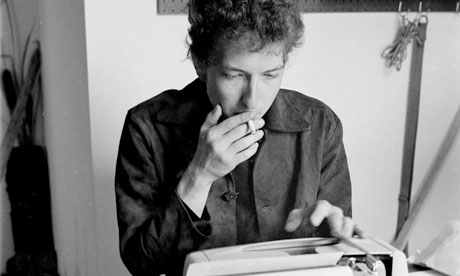
Dylan is not the brother who puts an arm around you after losing the ballgame like Bruce. He's not offering you a beer, or dropping in for a surprise visit on the way back from college or calling you up in the middle of the night to see how you're doing. He's really more like an uncle, an initiator, a darker figure in the background. He might be the brother back from the war, a silent presence smoking a cigarette in the dark; he's an older brother, someone who has seen so much and imagined so much more than no matter your awkwardness or pain or the strangeness of your questions and conclusions, he's been there.
He's a voice in your head affirming all possibility, a kind of ultimate affirmation, but it's tough love. He's the ancestor you think you had, or wished you had, the one who ripped himself out of the old country to make a new life. He's fearless, maybe a godfather more than a brother or an uncle. He's steady in the night, well-studied, wise, capable of soothing wild fantasies and asking you the essential question not only of rock and roll but the whole wide world after religion had officially passed the mantle of truth to philosophy and science and then on to literature and now, just like the Nobel Prize, it has been passed to rock and roll.
"How does it feel," your brother asks, "to be on your own, no direction home, a complete unknown, like a Rolling Stone?"
 Dylan is the definitive individualist, the anti-dogmatic, Romantic, wandering, unsatisfied, unbowed seeker in a world that Freud and James anticipated, Kafka writhed in, Carl Jung and Joseph Campbell teased out, and rock and roll ultimately owned. Like a mosaic floor of an abandoned temple scattered across a dry field without reason or rhyme, like the words of a newspaper William S. Burroughs would throw up in the air to make poetry and prose, like seventy years of family pictures scattered in the breeze, the organizing principles of our age are no longer what we are commanded by God or man, but rather how we feel. We ricochet from curiosity to passion to wasting time in the smallest corners of endless cubicles of consciousness that keep us all apart. For many, there's no more common Law, no more tradition, no more recognizable spirit weaving patterns through the days. There are only outlaws. There's living outside the law. All the rest is commentary.
"He was an outlaw, that’s for sure/More of an outlaw than you ever were," says Dylan of Lenny Bruce. We might say the same thing back to him, admiring his capacities and good fortune just a bit too much, but also understanding that if Dylan is a prophet—and he surely is not a prophet in the classical sense and surely dislikes being called one—he is a prophet of a world were everyone thinks him or herself a god, so many of us with the world in the palm of our hands but still restless and unsure about the purpose of it all.
"But to live outside the law you must be honest," Dylan sang in 1966's "Absolutely Sweet Marie." In a world where all truths are relative, individuals shape their own sense of honesty, of Law, of truth. That's a world where you miss your brother, the one you never had, the one who lays truth bare and asks the right question and lets you sit with it for as many years as it takes to feel the answer and see the world for what it really is. He's there, looking out the window, taking another drag of his cigarette, waiting for your answer, the one about who you really are. And if there's no brother to sit with you at the window, there's always the music of Bob Dylan. And does that feel? It feels great. Congratulations, Bob. You earned it.
***
For more on what Dylan really thinks of the Nobel Prize, look here:
***
And for more on Dylan, just because, visit here, here and here.