Showing posts with label Bible. Show all posts

Monday, April 11, 2016

Noah, Phil Ochs, and Us

ON THE ANNIVERSARY OF THE DEATH OF PHIL OCHS, thoughts on booze and Bible first published here and now published down there too...

It says in the Bible that Noah was the righteous man of his generation, which commentators of old noted was corrupt and twisted. Noah would have done well to make a Marxist exit from the Generation of the Flood – “Please accept my resignation. I don’t want to belong to any club that will accept people like me as a member” – rather than providing a floating vessel to save their sorry remnant.

Again thanks to Spotify, I recently reconnected with an album I once pilfered from my father’s record collection and then carried with me for years on a red-and-black 90-minute BASF cassette tape until it melted and died in a friend’s car: Rehearsals for Retirement by Phil Ochs.

Remember Ochs not as a pretender for the dubious Dylan folk crown or a master of the slightly grating topical songs of 1960’s coffeehouses. Remember him instead as an artist of great lyrical depth, melodic reach, and personal anguish. He killed himself after years of suffering in a Noahide struggle with booze and human frailty, eight years after the release of Rehearsals for Retirement in 1968. (We recall that Noah turned hard to wine once the deeds of the ark were done; whether out of despair for the world’s lot or the simple need to cut loose after all of that rage in a cage on the wild sea, we do not know.) Retirement is a stark foreshadowing of the way that Ochs’s own sensitivity and addiction would eventually drown him in the Flood.
As I understand it, Ochs enmeshed himself in the 1968 Democratic convention in the months before recording Rehearsals for Retirement. This chaotic event included offering a pig as a nominee for the highest office in the land. For Ochs, witnessing a crest of the violence and confusion in his political age left him bereft of hope for the future.
Midrash allows many liberties for allowing ancient dicta and narratives to make sense within a commentator’s reality, or to give sense to it. I imagine Phil Ochs’s words from the gorgeous, haunting title song of Rehearsals for Retirement in the mouth of Noah, both when Noah faces the task of saving some piece of flawed humanity, and after saving humanity, when he drowns in a frailty of his own:
Where are the armies who killed a country/And turned a strong man into a baby
Now comes the rabble/
They are welcome
I wait in anger and amusement/In my rehearsals for retirement
What’s the resolution to all this sorrow? I can’t tell you, although research continues. We are currently consulting with our musical neighbors the Yayhoos, whose “Between the Bottle and the Bible” we encountered first on Bob Dylan’s Theme Time Radio Hour:
Every day
Working on survival
It’s hard to choose
Between the bottle and the Bible
These are also words both Phil Ochs and Noah could have spoken.

Wednesday, October 14, 2015

That's Why I Love Mankind: Randy Newman and the Flood

It is said that "there is no early or late in the Torah" (Babylonian Talmud, Tractate Pesachim 6b). In other words, the sacred template of the Hebrew Bible can be reordered so that a phrase from the time of Adam and Eve explains an idea in Jeremiah or vice versa. It also means, if we extend this to the concept of commentary on sacred writ as a kind of textual time travel, that the house of study brings figures of every type and era under the same roof. As long as they have something authentic and meaningful to say about Jewish tradition, the conversation is open and the participants are contemporaneous.
Image result for randy newmanThat's how singer-songwriter Randy Newman - contemporary cultural commentator and religious cynic extraordinaire - joins us this week to help us think about Noah and the Flood, a signature tale not only of this week's Torah portion, but of all of sacred story.
The weather has gotten nasty. Forty days and forty nights of a downpour have washed out the very life for which the balance of sun, moon, rain, and sky are meant to provide. Sound familiar? It's South Carolina, Wisconsin, Utah, South Dakota, Texas, and Arizona in September. And, as told by Randy Newman, it's Louisiana, 1927.
What has happened down here is the wind have changed
Clouds roll in from the north and it started to rain
Rained real hard and rained for a real long time
Six feet of water in the streets of Evangeline
The river rose all day, the river rose all night
Some people got lost in the flood, some people got away all right
The river have busted through cleared down to plaque mines
Six feet of water in the streets of Evangeline
Louisiana, Louisiana
They're tryin' to wash us away
Playing the game of "no early or late" in commentary on sacred text makes it easy to apply the voice of Newman's narrator (from one of the most devastating natural disasters of the North American 20th century) to the world's most famous flood story. And as myths and archetypes go, it's hard to imagine that Randy Newman wouldn't have been thinking of Noah, who built an ark in order to corral his family and pairs of the animals while the rest of the world got lost in the rising waters.
"They're trying to wash us away," Newman sings. Who are they? Is it President Coolidge who appears in the next verse saying, "Isn't it a shame" to one of his advisers before returning to the north? Is it a divine force, that same angry, impatient, or - maybe even worse - apathetic creator who decides that the human project just doesn't matter anymore?
Newman's tune carries a tone of despair and helplessness tinged with anger that is fully opposite the feel of the biblical tale. In the Book of Genesis, a divine voice is unequivocal that God wants to destroy the entirety of mankind because it has failed to live up to the basic standards of justice God expects from God's creatures. Noah simply bows his head, listens, and starts building without a hint of challenge to the decree.
Religious critique - providing layers of color and questioning to a variety of traditions - is one of Newman's most wonderful songwriting traits. In "God's Song (That's Why I Love Mankind)," he sings:
Man means nothing, he means less to me
Than the lowliest cactus flower
Or the humblest Yucca tree
He chases round this desert
'Cause he thinks that's where I'll be
That's why I love mankind
Turning a religious tenet, tale, or unconscious touchstone on its head - as with the revolutionary concept that chronology does not limit our understanding of "before and after" in the Torah - is a core practice of commentary on sacred text. Comparing the lonely voice of the drowned-out farmer from 1927, or the burned-out divine voice of "God's Song" to the story of Noah, opens up a new window - like a window in Noah's ark as he gazes into the gray waters of the flood - and makes me think not of divine punishment, but of the responsibility we humans have for washing ourselves away.
Winter and summer are swapping places more and more; drought, torrential rain, changes in the weather that fit no pattern other than what science tells us is the result of climate change driven by humanity. To borrow a phrase from Newman, who paraphrases a divine watcher watching us as Earth slowly turns away from us, and we look to blame anyone or anything but ourselves: Doesn't it make you love mankind? Here, textual time travel forces contemporary introspection.
The story of Noah concludes with a verse that might suggest a way to think about the Divine, love, and mankind with more subtlety than the undeniable violence of God turning the world upon God's creation. Noah has a direct line to the Divine and is called the "righteous man of his generation". After everything, in a reversal of the extreme decree of destruction against humanity that prompts the Flood, when the waters begin to lower and Noah and his family finally come back to the land, God blesses them to restart the human project, never to be drowned out again.
Image result for randy newman that's why i love mankind"Then God said to Noah," it is written, "'Yes, this rainbow is the sign of the covenant I am confirming with all the creatures on earth'" (Genesis 9:17). It's as if a love song after the storm appears in the sky, a statement of a kind of unconditional love between two entities -divine and human - that have taken each other to the brink. Even Randy Newman admits at the end of "God's Song" that there is a dependency between the two players in this all-stakes drama, one that is very difficult to shake. "You really need me," he sings. "That's why I love mankind."
In sacred stories so thick with meaning, the mix of voices spanning time and space challenge our settling into any single meaning. Narratives and counter-narratives are built into Jewish tradition, which invites interpretation and reinterpretation in a constant dance - with both the destroying flood and the protecting ark, as well as love and despair, flowing together through the world of imagination where Randy Newman and Noah meet.
This post originally appeared here in the Huffington Post. 

Sunday, May 17, 2015

Long Live the King: B.B. King

Long, long time ago I decided to leave school, pack a rucksack and guitar, and try to touch all forty-eight states in the continental US. My cousin agreed to join me for the first leg of the trip, a swing through the south that brought us to New Orleans where we teamed up with a more seasoned traveler who convinced us against our better judgement to continue on to Mexico where we wrecked our car and were stranded for two weeks. I made it to California eventually, started a band or two, and kept looking for a code that would shape me.

Music was my guiding star then as now, and the symbolic crossroads, the place where that whole journey out of one life and into another started was the Front Row Theater. There I saw B.B. King, Albert King and Bobby "Blue" Bland two nights in a row.

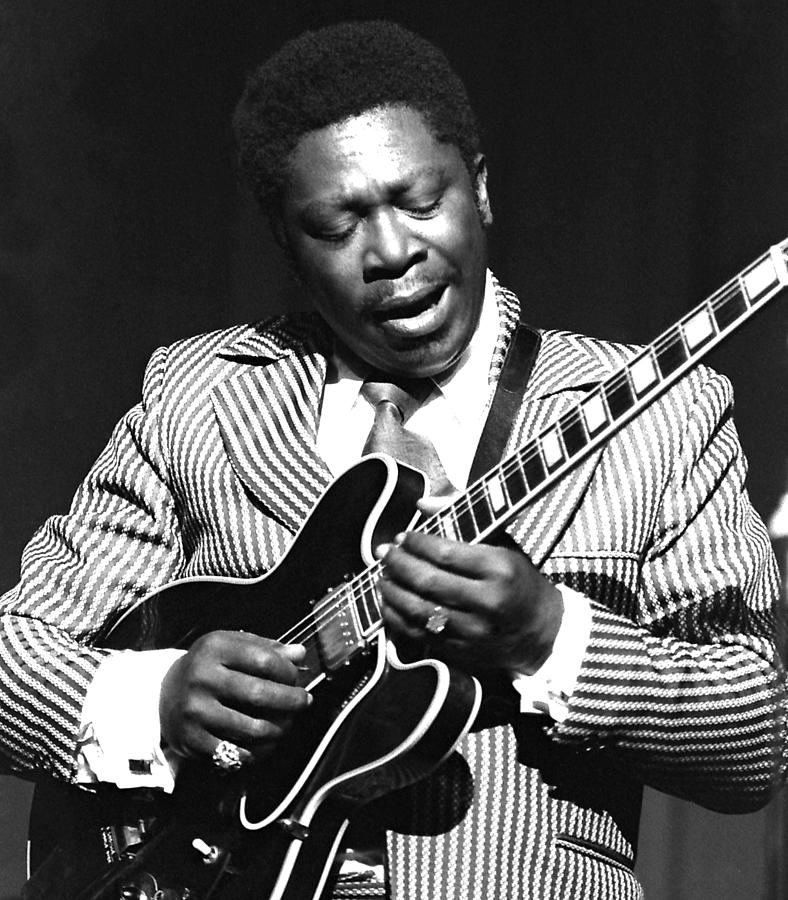
B.B. King: smooth searing guitar, weeping and wailing and sailing above the stars; a booming voice full of love and humor; a grimace, a smile, warm words he had shared thousands of times with his backing band and his audience as he sweated and shimmied and glowed.

The recordings of the live shows were always my favorites, and seeing him live for the first time was a pilgrimage to witness a liturgy of the heart enacted by a High Priest who gives life to his people. I still know many of those albums note by note, having played along best as I could for years, eyes closed, imagining myself trading licks with a father, a grandfather, a great grandfather who -- despite lifetimes of difference between him and me -- assured with the giantness and gentleness of his person and music not only that the blues were an invitation I could accept, but that accepting the blues meant accepting love, and never being alone, and that even in the lowest, saddest of times the good work could get done, hauling sorrows and joys hand over hand with the King of the Blues, the One, the Only, B.B. King.

His music goes so deep -- deep as darkest dark. Yet it also buzzes with zest and vigor like purest light. There was a threshold across which B.B. King and his friends who taught the blues -- especially the electric blues -- carried an entire culture. That basket of blues held the possibility of all things, just like the arks that the Israelites carried out of Egypt.

"What's in those arks?" the passersby would say.
"One holds the Holy Torah and one holds the bones of Joseph," they replied.
"But how can you carry the living alongside the dead?" they asked.
"If not for this one, that one never could have been," they said.

Without music, it's hard to image living, but rising up for me as he did when he did, B.B. King was the rare musician whose warm, wise, simple, booming greatness offered an embrace so perfect amidst the imperfection of the world that it's hard to imagine my life itself without him.

That's a King for you, and this is his kingdom -- and feeling this way about these things is something grand and pure that cannot be explained. The King is dead. Long live the King.


Monday, December 15, 2014

I and I: Where One's Nature Neither Honors Nor Forgives

Jacob's struggle in the Torah portion Vayishlach (Genesis 32:4-36:42) is framed by revelations about the meanings embedded in places and names. Nothing surprising there -- who gives a name, what that name means, and how a place becomes known for the transformative moments occurring upon it, all define much of the biblical story.
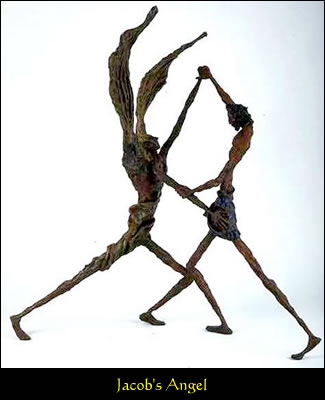
Jacob's Angel
Part of the collection of the Ratner Museum.
Click here for more from the collection.
Vayishlach begins with our hero on the run. Recall that Jacob emerges from his mother Rebekah just moments after his twin brother Esau; in adulthood, with his mother's help, he tricks his blind father Isaac into giving him the blessing intended for the firstborn. Esau vows to kill Jacob, and even after establishing a large family and formidable wealth and power, Jacob still fears his brother as he waits for a fateful reunion alone by the banks of a stream.
Something or someone visits him that night: "Jacob was left alone. And a man wrestled with him until the break of dawn" (Genesis 32:25). Some say that this man is Esau. Others think it is an angel, a messenger of the divine. Still others believe that Jacob wrestles with himself. Whomever or whatever Jacob tangles with, morning comes and he names the place of his struggle Peniel ("Face of God") before limping off to meet Esau.
This is the first of three critical junctures in this Torah portion where names and places mark the essence of a family-nation's entanglement with the divine. A few verses later a recalcitrant Jacob tells Esau "to see your face is like seeing the face of God" (33:10), echoing the language of Jacob's naming of the place where he wrestled. And finally, in chapter 35, God appears before Jacob and changes his name to Israel, literally "Wrestler with God".
In addition to a focus on names and places as windows onto the holy, questions about just how and whether humans and the divine come face-to-face mark Jewish lore at every stage and in every era. Consider the case of Moses, God's mouthpiece and arguably closer to the mysteries and power of the divine than any biblical figure. He asks for a direct encounter with God, and is told: "You cannot see my face, for no man can see me and live" (Exodus 33:20). So which one is it? No one, not even Moses, will be allowed to see the face of God and live, and yet Jacob/Israel, like an entire chain of biblical heroes, seems to be hardwired to see God's face everywhere he looks.
Biblically-inspired imaginations still wrestle today with the question of who and how people might experience the Divine Presence. Bob Dylan's "I and I" from 1983's Infidels could serve as the theme song for any number of biblical figures struggling with the apparent paradox of divinity being both too close to them and too far away. Here Dylan asks how a seeker honors the divine spark within him- or herself, and notes the eminently human struggle that this balancing act requires.
I and I
In creation where one's nature neither honors nor forgives
I and I
One says to the other, no man sees my face and lives
Alluding to the ancient teaching from Genesis that all people are created in the divine image, Dylan describes a person shaped by the continual conflict of human and divine elements. People are defined by their contradictions, some of the deepest of which are a kind of "face-off" in which they cannot see their true selves any more than they can see the divine. And yet, the divided self in "I and I" is also a self that wants to see its other half, always gazing upon itself "eye to eye." As Jacob knows, facing the divinity of both the other and one's self is not without its risks -- among them, burnout from the intensity of this engagement, and the soul-killing arrogance of experiencing oneself as greater than someone else, especially one's kindred.
In his 2012 song "Show Me the Place," Leonard Cohen, another contemporary commentator on ancient wisdom, both articulates the desire for the divine encounter and offers an approach to grounding that encounter in humility:
Show me the place
Help me roll away the stone
Show me the place
I can't move this thing alone
...
Show me the place
Where you want your slave to go
Much of Jacob's story concerns discovering the kind of humility about which Cohen sings. To his mother, he is a golden boy who should be given more than he deserves. To his brother, he is a triumphalist trickster. While family hubris continues with Jacob's and Rachel's son Joseph, who is humbled when he is sold into slavery by his brothers, all of Jacob's clever victories bring him face to face with challenges of chosenness and leadership that will define much of the Israelite story to come -- that is, experiencing directly the blessing of the Divine Presence, constantly wrestling with the meaning of this gift, and submitting in some form to powers greater than one's self in order to fulfill the promise of a calling.
This is a place, the place of struggle, where "one's nature neither honors nor forgives" and grand ambitions are grounded by a humble spirit of service -- almost like a slave, or at least a servant. When a leaders loses this balance between ambition and humility, the call of conscience in darkest night, or the face of an enemy they know they have wronged in order to survive, reminds them who and where they really are: right back in that place of wrestling "eye to eye" and "I and I" once again.
This piece originally appeared here in the Huffington Post as part Seventy Faces of Torah, a pluralistic Jewish scriptural commentary, produced by The Center for Global Judaism at Hebrew College, in which thought leaders from around the world offer insights into the weekly Torah portion and contemporary social, political, and spiritual life. 

Sunday, May 11, 2014

Zion Train: Bob Marley and Theodore Herzl

Today, the 11th of the Hebrew month of Iyar* and 11th of May, is both Theodore Herzl Day and the anniversary of the death of Bob Marley.

Bob Marley, lover of Zion, a prophet and seer, Rastafarian and messianic believer, iconoclast, natural mystic man, voice of struggle and liberation. He died young and exhausted, having traveled the world with a message born long before him that he reenchanted, reenergized, and that continued to bloom long after he had gone. 

Theodore Herzl, lover of Zion, a prophet and seer, Jew and messianic believer, iconoclast, natural mystic man, voice of struggle and liberation. He died young and exhausted, having traveled the world with a message born long before him that he reenchanted, reenergized, and that continued to bloom long after he had gone. 

Bob Marley sang:
Zion train is coming our way
The Zion train is coming our way
Oh, people, get on board
Thank the Lord
I gotta catch a train, 'cause there is no other station;
Then you going in the same direction 
Zion's train is coming our way
The Zion's train is coming our way 
Which man can save his brother's soul?
Oh man, it's just self control.
Don't gain the world and lose your soul
Wisdom is better than silver and gold
To the bridge
Oh, where there's a will
There's always a way
Where there's a will,
There's always a way 
Soul train is coming our way
Zion train is coming our way 
Two thousand years of history
Could not be wiped away so easily
Two thousand years of history
Could not be wiped so easily
Oh, children, Zion train is comin' our way
Theodore Herzl
Theodore Herzl said:
Some people do not understand us correctly and believe that the goal of our effort is to return to our land. Our ideal is going forwards then that - our ideal is the vision of the Great eternal truth; it is an ideal that always goes forward; it is an ideal that never ends, it is always growing, so that every step forward that we take, our horizon keep going ahead of us, and in perspective we see before us the purpose that is greater and more noble, which we’ll try to put ourselves towards.*

Here's to wild dreamers, huge hearts, and continuing echoes of best laid plans for Zion.

*Theodore Herzl Day is held on the 10th of the Hebrew Month of Iyar, which fell on Shabbat this year, pushing celebration to the 1th.

**Thanks to my friend Yair Bamberger for pointing out the special shared significance of this day.

Tuesday, May 6, 2014

Leviticus: Keeping Holiness Simple

This article originally appeared on the Huffington Post. Read it here.
For centuries, formal Jewish study began not with Genesis, the first book of the Hebrew Bible, and not with the Mishna, the first codex of lived Jewish law, but with Leviticus, also known as Torat Kohanim, or the Book of Priests. While focusing in many sections, like last week's portion of Emor, on practices and obligations of the priestly class, Leviticus addresses all Israelites as a "nation of priests" whose relationship with holiness is nothing less than a matter of life and death.
Seeking holiness is the ethos of the Hebrew Bible from Adam and Eve on down. If wondering and worrying about holiness lives most vividly in Leviticus, then the heart of Leviticus is the "Holiness Code" (Lev 17-26) with which this week's Torah portion, Behar, concludes.

Holy Moses! This puts Beharin a pretty dramatic spot. How can any set of verses conclude a litany about holiness, which the Hebrew Bible claims is the essence of the meaning of life? Only by hitting us squarely in the places where so much of mundane life is lived and so much of holiness is lost and found. Behar wants to talk about our pocketbooks and our obsessions to show what it means to engage the ultimate truths that holiness holds.
What's in Your Wallet?
The answer to the question "What's in your wallet?" in ancient days was quite different than the answer to the same question today. For one thing, the answer in biblical times was almost universally "nothing" because subsistence was the name of the game. We might know stories about the wealth of the pharaohs or King Solomon or the occasional tribal fat cat, but for the 99 percent who were not royals, chieftains or members of the priestly class stationed at the top tier of Temple life, life was a hand-to-mouth struggle.
The economy of Leviticus revolves around animals, land and slaves, not money. But the irony of comparing issues of wealth or poverty then to now -- and perhaps one of the most powerful reflections on the human condition that one could ask to learn from an ancient text -- is that the economic challenge to pursuing holiness remains the same: When it comes to seeking holiness, nothing requires more effort or more intense partnership between humans and a higher power than confronting the scourge of debt.
Our portion lays out clear rules about avoiding any kind of financial servitude, including prohibiting interest on loans (Lev 25:37), restricting service of indentured servants and laborers (Lev 25:40) and banning servitude of these types for the offspring of those stuck in it (Lev 25:41).
The most extreme form of debt is slavery, a fall into the red so deep that it offers no possibility for redeeming one's basic human station. Leviticus demands that all people have direct access to redemption from debt, which shackles people from moving towards holiness.
Redemption from debt is not limited to people. In fact, the land itself must be redeemed as well. Beharoutlines sabbatical years in every seventh year -- just like there is a Sabbath of rest every seventh day (Lev 25:1-7). Nothing can be planted in the sabbatical year and both people and animals can eat only what the untended land offers. (Check out some of the work the organization Hazon is doing as next year's sabbatical approaches -- yes, it remains a very live issue, particularly in the Land of Israel.) A Jubilee, the 50th year of each cycle of seven sets of seven years, serves as a complete societal reset, not only in terms of planting and eating, but also in terms of redistributing properties towards societal balance (Lev 25:8-12). In addition, the Jubilee is the year where all slaves are set free.

Imagine how radical this system for wiping out debt and harmonizing humans, animals and the land would be if implemented in full today. Take all of the debts you hold -- all of what is or is not in your wallet including credit cards, mortgages, student loans, payment plans to healthcare providers, and on and on. Now simply erase them. The same, of course, is true of whatever others owe you. It just disappears. Holy Moses indeed -- this is a radical program for holiness.
Obsession and Idolatry
When it comes to obsession in days of old, we can guess by the sheer number of prohibitions in the Hebrew Bible that people could find all kinds of way to busy themselves. But the ultimate term for an obsession leading people away from holiness is idolatry, which is the final word of Behar and the Holiness Code in Lev 26:1:
You shall not make for yourselves, or set up for yourselves carved images or pillars, or place figured stones in your land to worship upon, for I the LORD am your God.
It is possible to understand the Hebrew Bible's abhorrence of idolatry in many ways. Differentiation between Israelite religion and that of its neighbors; an honest to goodness divine judgment about what kinds of worship works and what kind doesn't; assertion of priestly power; or any number of mysteries too ancient to discover. It might make the most sense to understand the terror about idolatry as a broad definition of the worldly attentions that can distract, distort, or usurp pursuit of holiness.
The most famous idol ever is probably the golden calf, which some rabbinic legends hold was actually created out of the precious metals the Israelites had lifted out of Egypt. Melded by Aaron, Moses' brother and the first Israelite priest, the golden calf so disrupts the pursuit of holiness that Moses smashes the first set of Ten Commandments meant to make the pursuit of holiness real. It's no wonder Behar wanted to make the Israelites remember what and with whom they are dealing with at the close of the Holiness Code.
"Be Holy!" says Lev 19:2, read two weeks ago. In summarizing a primary biblical goal already expressed fully in just two words, Behar, which is the shortest Torah portion in Leviticus, keeps it simple: If you want to be holy, remember that you are no man's slave -- and that no man is your slave; nor is the land your slave; and remember too that all forms of wealth are of only transient value. Then, once the nitty gritty of debt and redemption has been reviewed, the Israelites are asked not to be distracted by obsessions that sway the senses as they go and seek and serve. Just like traditional study of the Hebrew Bible, this is the place -- codes and questions of holiness -- where the biblical journey begins.