Showing posts with label Greil Marcus. Show all posts

Thursday, April 7, 2016

My Salvation? Jude, Elijah and Bob Dylan Revisited


Recently I had the great pleasure of giving a lecture at the University of North Carolina at Asheville on Bob Dylan  – about Bob Dylan and Man and God and Law to be precise. This reminded me that it's about time to put together work and thinking on Dylan and religion in a book. So over the next few months, that's what I intend to do.

And this work sends me back to some of the writing I have delighted in sharing about Dylan and matters of the spirit over the years. Check out this piece on I'm Not There, Todd Haynes' wonderful reworking of a very Greil Marcusian vision of Dylan (that we dig) and his own delicious view of the music, the man, art, love, quests and all other kinds of good stuff. Elijah and Julie Taymor's "Across the Universe" show up too.

Find the piece in original form here, or in full below.


When poet-provocateur Allen Ginsburg pulls up in a golf cart on the side of the highway and asks, “What now?,” Jude – one of six versions of Bob Dylan in Todd Haynes’ film I’m Not There – looks at the sky, his face colored by the desperation and irony that have animated every mask he has worn in a long and unpredictable career. “My salvation?” he half mumbles, both a question and an answer. After they shake hands goodbye, Ginsberg veers off the road toward a cemetery, saying: “Well, we’ll see what we can do.”


Like most of Haynes’ film, the first meeting between Bob Dylan and Allen Ginsberg is constructed of a fluid association of anecdotes, lyrics, and wishful thinking, but like any good poetry, it gets closer to the truth than what may or may not have actually happened.

Dylan’s calling towards salvation – what Ginsberg in the golf cart deems both “mission” and “coercion” – is literal, religious, mystical, or otherwise playfully disembodied and transcendent from day-to-day life; and this calling is what flips Dylan’s story forward through a deck of cards of identities including rail riding troubadour (ten year old Marcus Carl Franklin), rebel folkie (Christian Bale), romantic poet (Ben Whishaw), Jude the revolutionary rocker (a masterful Cate Blanchett), megastar family man (Heath Ledger), fundamentalist preacher (Christian Bale, again), and frontier loner (Richard Gere).


“I bargained for salvation an’ they gave me a lethal dose,” Dylan wails in 1974’s “Shelter from the Storm.” And so it goes for artists with creative vision, arrogance, and stamina as deep as his. From Dante to Shakespeare to William Blake, salvation has always been the ultimate destination: the “what now,” the just around the corner, the just within reach, and the never quite real enough to keep.

It has taken Dylan a lot of disguises to stay safe on this trail, and cinematographer Edward Lachman, nominated for an Oscar for his last collaboration with Haynes in 2002’s Far From Heaven, captures long, patient frames and shotgun flashes of Dylan face-to-face with truly lethal doses of salvation, moments when the messiness of life forces the high flyer back to the ground.

Three of these instances stand out: the cocky young singer just arrived in New York, seated sorrowfully before Woody Guthrie dying in hospital bed in 1961; Ledger’s silent despair, sorting family photos after a messy mid-70s divorce; and above all, the tight mask of the ultra hip, self-invented rocker dissolving at the betrayal of a snooty British journalist nemesis who reveals that Jude the legend is in fact a Jewish kid from Brookline, MA named Aaron Jacob Edelstein – the film's version of Robert Zimmerman of Hibbing, Minnesota.

A Tale of Two Wandering Judes
Dylan’s Jude is not the only star by this name rising on cinema screens this season, as the myths of the sixties – and an endless supply of commercials – continue to evolve through the voices of the song books of the masters of the age.

The lead wanderer of Julie Taymor’s story of 60's life and the Beatles, Across the Universe, is named Jude as well; part of the conceit of Across the Universe is to give its characters names out of Beatles songs (Jude's housemates include Prudence, Sadie, and Lucy, and Bono puts in a show-stopping cameo as the hallucinogenic Dr. Robert) so ultimately the entire narrative of the Sixties is told by Beatles songs and enacted by the characters themselves. And just as Dylan/Jude’s marriage unravels with images of the Vietnam War searing television screens in the background in I’m Not There, so too are Taymor’s Jude and his buddies unraveled by bombs in the rice fields of Asia and the streets of New York. It turns out that when it comes to the seemingly eternal music of the golden age of rock and roll royalty (Dylan and the Beatles no doubt sharing the throne above any other pretender to it) beautiful music makes more cultural than historical sense. Yet despite music's naive claims to transcend history, the world is too messy and life too absurd not to leave a scar.

These are the tales of two very different wandering Judes. Despite the thump, holler, and grit of rhythm and blues amidst a catalogue of perfect melodies, the Beatles were really always all about love. It's not hard for Taymor to imagine a happy ending in the musical clues she pieces together, creating a simple love story to soften realities’ growl – even when, as here, that growl includes post-traumatic stress disorder, deportation, and alienation. Jude comes home again regardless of history’s claims upon him, escaping the war, capturing the dream, and eventually getting the girl – because “All You Need Is Love.” But for Dylan/Jude as well as all of the other personae in I’m Not There, the lessons of nearly fifty years of recorded music and thousands of live shows cannot help but end precisely where it all began: facing down mortality and corruption while capturing fleeting beauty in choppy frames of recognition and loss.
Taymor’s film falls flat even as the soundtrack soars because “All You Need Is Love” is simply impossible to believe after what the Sixties as a cultural moment have became – thick with nostalgia and self-congratulation – while Dylan’s story, at least in this version on film, remains raw and troubling despite the pleasure it brings. Both films end on a note of redemptive music – though Gere's Dylan/Billy loses his home and even his dog, he rediscovers the power of old forms of music and hits the road, much like Dylan in the most recent decade and a half of his career. And both end on a note of indeterminacy too. But there is a nostalgic fondness in Taymor's film; it loves to look back. Dylan, like the title of Pennebaker's famous film, always says "Don't look back."

“But I know I Ain't No Prophet”
All these people that we used to know                                   They're an illusion to me now.
Some are mathematicians
Some are carpenter's wives.
Don't know how it all got started,
I don't know what they're doin' with their lives.
But me, I'm still on the road
Headin' for another joint
We always did feel the same,
We just saw it from a different point of view,
Tangled up in blue.
Stories of Elijah’s countless masks, rages, and demands are embedded throughout Jewish folkways. Elijah, like the early Dylan, wants to speak truth to power – and like that Dylan, he succeeds too well; the people fall for trickery, choose God for the wrong reasons, and eventually Elijah runs away. In exile, Elijah finds the eternal not in the earthquake or the fire, but in a still, small voice, perhaps, we might even say, one which sings. Then, with the command of God at his back, he covers his face, proclaims his zeal for justice, and, despite the many enemies before him, takes to the road, an outlaw ever since. 
Elijah is most famous for the moment he does not arrive at all, his wine glass untouched but for the banging on the Passover table as a child wakes with a start to open the door. The prophet makes no sound, raises no hand, and opens no gates to salvation on the holiday when the Exodus from bondage in Egypt is replayed by all who come to celebrate it. “I’m Not There,” he might say as people seek him with eyes tightly shut, not wanting to know what a lethal dose of salvation might really mean.

The image of the Wandering Jude of Dylan’s oeuvre, unsatisfied with the world as it is and still staying on the road to salvation in spite of it, shares much with another long traveled image of paths of glory, the tireless prophet Elijah.

But just as Dylan says, “To live outside the law you must be honest,” in Jewish tradition Elijah can be found everywhere, in disguise, at the gates of a city in the morning and in the houses of royalty by night; he blesses the poor, unsettles the rich, and continually shuffles the deck of fate with his many faces – like the imagined Dylan of I’m Not There– to keep people honest and humble and locked in real time.

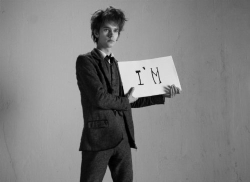
Imagine the titles of the three great films on the life and work of Bob Dylan as they might appear in the famous scene of Dylan flashing and dropping cue cards (Allen Ginsberg davening, tongue and cheek, wrapped in a prayer shawl in the background): “Don’t Look Back” – “No Direction Home” – “I’m Not There.” So too goes Haynes’ deep, passionate take on the many lives of Dylan’s seeking: flashes of intimate, gorgeous meaning that stay; and always waiting for just a little bit more.

Sunday, November 30, 2014

Rebellion and Fun: A Glimpse into the History of Rock 'N' Roll

As reported with all due diligence on this blog in the hot summer of 2014, I recently taught a course entitled The History of Rock 'N' Roll (and Everything in It) in Ten Songs at Shalem College. Inspired by Greil Marcus' The History of Rock 'N' Roll in Ten Songs. I divided rock history into themes carried by ten tunes. (The list actually went up to eleven, but it was close enough for rock 'n' roll.)

Read more about the course here and the themes of Rebellion & Fun, Prophecy, Love & Friendship, and War & Work & Sex & Death by following the links.

Below you can watch a brief clip on the theme of Rebellion & Fun, calling on music by Chuck Berry, the Beatles, the Bently Boys, and Bob Dylan


The full list of songs from the course play list appears here:

One: Rebellion & Fun*
  • Chuck Berry, “Roll Over Beethoven” (1956)
  • The Replacements, “Bastards of Young” (1985)
  •  The Crystals, “He’s a Rebel” (1963)
  • David Bowie, “Rebel, Rebel” (1974)
  • Tom Petty, “Rebels” (1985)
  • Tracy Bonham, “Mother, Mother” (1996)
  • Little Richard,“Tutti Fruitti” (1955)
  • The Beatles, “She’s Leaving Home” (1967)
Two: Prophecy, Love & Friendship
  • Patti Smith, “Gloria: In Excelsis Deo” (1975)
  • Them, “Gloria”
  • Blind Willie Johnson, “John the Revelator” (1930)
  • R.E.M., “It’s the End of the World as We Know It (And I Feel Fine)” (1987)
  • Aretha Franklin, “I Never Loved a Man (the Way That I Love
  • You)” (1967)
  • Bruce Springsteen, “Backstreets” (1975)
Three: War & Work
  • David Crosby (The Byrds) after “Chimes of Freedom” at the Monterey Pop
  • Festival (1967)
  • Jimi Hendrix, “The Star-Spangled Banner” at the Woodstock Festival (1969)
  • The Rolling Stones, “Gimme Shelter” (1969)
  • The Bently Boys, “Penny’s Farm” (1929)
  • Bob Dylan, “Maggie’s Farm” (1965)
Four: Sex & Death
  • Meatloaf, “Paradise by the Dashboard Light” (1977)
  • Crosby, Stills, Nash and Young, “Ohio” (1970)
  • Nirvana, “Smells Like Teen Spirit” (1991)
*Songs in bold are the 10 main songs of the course; other songs on the list helped us understand them.

Thursday, July 24, 2014

The Mythology of Bob Dylan and Leonard Cohen I: Creation


As a great poet once said: Let us compare mythologies. 


Last week at Shalem College we completed The History of Rock 'n' Roll (and Everything in It) in 10 Songs. Now we enter another rock 'n' roll challenge: charting, comparing, and understanding the mythology at the heart of the work of Bob Dylan and Leonard Cohen.

Mythology rules today just as it always has, shaping our essential conceptions about life, the world, and everything. Joseph Campbell writes in The Hero with A Thousand Faces:

Myth is the secret opening through which the inexhaustible energies of the cosmos pour into human cultural manifestation. Religions, philosophies, arts, the social forms of primitive and historic man, prime discoveries in science and technology, the very dreams that blister sleep boil up from the basic, magic ring of myth.

Greil Marcus extends this thinking into the realm of rock in his introduction to Stars Don’t Stand Still in the Sky: Music and Myth, a beautiful collection edited by Karen Kelly and Evelyn McDonnell:
This was a myth you could join by allowing it to judge the choices you made: between friends, between going to college or not going, studying one thing and not another, between clothes you put on and those you set aside—the choice you made, finally over just what country, as you defined it, you would be a part of, if you were to be part of any country at all.
Bob Dylan and Leonard Cohen both have had long and fruitful creative careers, producing a huge amount of material to consider. Ordering it with eight themes brings focus to the arc of mythic story these artists tell. 

The themes are:
  • Creation Myths 
  • Masters and Teachers 
  • Dreams and Visions 
  • Gods and Angels 
  • Journeys and Battles 
  • Places 
  • Sacred Stories 
  • The Law

In addition to encountering Cohen and Dylan, special guests in this two-week course will include Franz Kafka, Abraham and Isaac, Joan of Arc, Robin Hood, King David, Satan, Buddha, Aphrodite, the Angel Gabriel and the Angel of Death, Shakespeare, and a carpenter from Nazareth, his mother and his apprentice. 

Creation Myths
Artists are self-inventors. This is particularly true of rockers. From Joan Jett and David Bowie to Madonna and Prince, rock 'n' rollers create myth-laden names, identities, voices, and appearances that proclaim a place in the world different than everyone else. So too Dylan and Cohen, who conceive of their own roots creatively—how and where they were born and what shaped them—just as ancient tellers imagined the superhuman coming-of-ages of Moses or Jesus or Achilles.

In "My Life in a Stolen Moment," a poem published in 1962, Bob Dylan describes himself as a precocious, orphaned, rambling outlaw-in-training who has been looking for trouble and purpose since he ran away from home at the ages of "10, 12, 13, 15, 151/2, 17 an’ 18:"

With my thumb out, my eyes asleep, my hat turned up
     an’ my head turned on
I’s driftin’ an’ learnin’ new lessons
I was making my own depression
I rode freight trains for kicks
An’ got beat up for laughs
Cut grass for quarters
An’ sang for dimes
Hitchhiked on 61 — 51 — 75 — 169 — 37 — 66 — 22
Gopher Road — Route 40 an’ Howard Johnson Turnpike
Got jailed for suspicion of armed robbery
Got held for four hours on a murder rap
Got busted for looking like I do
An’ I never done none a them things
Somewheres back I took time to start plain’ the guitar
Somewheres back I took the time to start singin’
Somewheres back I took the time to start writin’
But I never did take the time to find out why


Dylan makes his "own depression" and bounces around backroads and jails, guitar in hand, so that he can inhabit a romantic, mythic reality that grounds his life in something grand. 

In Leonard Cohen's 1960 poem "One Night I Burned," he describes a house—maybe his house of family origin and maybe a later, more grown-up home—as place of perfection he must burn and flee in order to become the person he wants to be:

One night I burned the house I loved,
It lit a perfect ring
In which I saw some weeds and stone
Beyond – not anything.

Certain creatures of the air
Frightened by the night,
They came to see the world again
And perished in the light.

Now I sail from sky to sky
And all the blackness sings
Against the boat that I have made
Of mutilated wings.
  
But Dylan and Cohen need to do more than craft a creation myth of the place from which they have come. They must also conceive of the place and purpose to which they are headed. This the myth of how their unique birth blossoms into an embodiment of a calling only they can fulfill. 

The list of songs describing each these artists' calling as mythic artists is, well, kind of mythic. They have produced scores of maps and liturgies towards discovery that millions of people have used to shape their own yearnings to make a life. 

We will make do with one song from each artist: Dylan's "I and I" and Cohen's "Show Me the Place." 


In "I and I" Dylan tends to a melancholy tale of a lone wanderer who is clearly descended from the hardscrabble urchin of "My Life in a Stolen Moment:"

Noontime, and I'm still pushin' myself along the road, the darkest part
Someone else is speakin’ with my mouth,
but I’m listening only to my heart
I’ve made shoes for everyone, even you, while I still go barefoot

I and I
In creation where one’s nature neither honors nor forgives
I and I
One says to the other, no man sees my face and lives
                                                                   

As we will hear often over the next two weeks, Dylan combines raw urges for seeking and poetic lucidity in a story that shows him wrestling with love, loss, and the divine in equal measure.  


Cohen describes himself as similarly melancholy and placeless, echoes of "One Night I Burned." Often, particularly in his later work, bowing to his burdens results in servitude that affirms his purpose, even as it leaves him humbled.

Show me the place
Where you want your slave to go
Show me the place
I’ve forgotten, I don’t know
Show me the place
For my head is bending low
Show me the place
Where you want your slave to go


And so, with "I and I" and "Show Me the Place" as their first musical statements of purpose, we begin to seek the seekers.

Stay Tuned

For a lover of myth and music, it does not get much better than having the chance to prepare the songs, texts, reflections, and images that will guide a stroll through the gardens of some of the most profound artistry of the past half century.

Starting this Sunday evening, I will be writing about what the students and I find in this work. I look forward to seeing you here. And for those who want to hear more, join me Wednesday July 30 and August 6 at 3 PM EST to listen to some of these songs live from Jerusalem on JLM.FM. My commentary will be in Hebrew, but, as they say, the song remains the same.

Next Up: Masters and Teachers

Monday, July 14, 2014

The History of Rock 'n' Roll: Rebellion and Fun

This summer I am teaching a course entitled The History of Rock ‘n’ Roll (and Everything in It) in Ten Songs at Shalem College. Read more about the course plan here. Below is the first installment describing what the students and I find...
Our task is daunting: ten songs to map the history of rock and everything in it. 

We began by tracing stories of rebellion and fun with these tunes:
  • Chuck Berry, “Roll Over Beethoven” (1956)
  • The Replacements, “Bastards of Young” (1985)
  • David Bowie, “Rebel, Rebel” (1974)
  • Tracy Bonham, “Mother, Mother” (1996)
  • The Beatles, “She’s Leaving Home” (1967)* 
*Songs in bold as part of the core ten songs of the course.  
In this telling of rock, the stories wrapped themselves around each other to become a woman's tale. She moved through four decades of rock 'n' roll as a ghost of many forms - sometimes a child, sometimes a parent; she was a performer, performed upon, and an audience as well. 


Chuck Berry, "Roll Over Beethoven"

She begins innocently, tagging along for fun in Chuck Berry's "Roll Over Beethoven:"

You know she wiggles like a glow worm,
dance like a spinnin' top.
She got a crazy partner,
Ya oughta see 'em reel and rock.
Long as she got a dime the music won't never stop.

Plugging dimes into the jukebox whose repetitive rhythms pull her close, she's found a beat and a partner and they've got their moves while Beethoven - the one she is supposed to love - is just a zombie, half memory and half man but all in the grave. There might be something creepy in the air, but no one is yet all that far from home. She and her friends may have contracted "rockin' pneumonia" and "rollin' arthiritis," but no one is limping, no one has gone off the rails.

But dime after dime in the jukebox ultimately releases something contagious and foreign that follows her back home. The Beatles named it in "She's Leaving Home." A restless daughter well-loved still needs to leave her sleeping parents who "gave her everything money can buy." She tip-toes out and away with tears in her eyes. Money can't buy her love and "fun is the one thing that money can't buy." So she leaves her mother and father for a partner. Maybe not Chuck Berry's crazy partner. He's a man from the motor trade. But as she sets off down the rock 'n' roll highway there is no way of telling what will be.


David Bowie, "Rebel, Rebel"

Times gets stranger. By "Rebel, Rebel," mother is "not sure if she's a boy or a girl." She has found lots of fun, probably too much fun. Her face is a mess and she's torn her dress. That's part of breaking down what ever had held her back before, of course, but the purpose of all of this noise and striving remains unclear. David Bowie asks:

So what you wanna know Calamity's child,
Where'd you wanna go?

Maybe somewhere, maybe nowhere, but the girl becomes a woman who becomes a mother. She travels far but only far enough to become the very same middle-aged woman whose sons and daughters now start their own band. Call them the Replacements: angry, realistic, charming, and drunk. 

These kids of the 80's had parents who turned over Beethoven with the addictive beat of the juke box, frightening and surprising their parents, but it does not save them them from the same mistakes and boredom that shaped the first generation that raised itself at rock's knee. 

"Clean your baby womb," the Replacements sing:

Trash that baby boom
Elvis in the ground
There ain't no beer tonight 

Elvis is the new Beethoven, but not even live enough in death to roll over.

Tracy Bonham, "Mother, Mother"

By Tracy Bonham's "Mother, Mother," teen rage and rebellion which rock 'n' roll had natured and sold are as standard as a man from the motor trade. A girl can screech and howl just as loudly as a boy. That's good news. But rock pneumonia, even as it is translated in two or three generations of record-making, festers and the kids are not quite all right:

I'm hungry, I'm dirty 
I'm losing my mind, everything's fine!
I'm freezing, I'm starving 
I'm bleeding to death, everything's fine!

It's not clear what the call to rebellion that breaks down barriers of gender and culture and breaks up the home has actually done. 

Yoel Botnivick found Calmity's Child - the specter of a woman holding many different forms - rounding a corner on the Rolling Stones' Bridges to Babylon just about the same time as Tracy Bonham's "Mother, Mother:"

Anybody seen my baby 
Anybody seen her around 
If I just close my eyes 
I reach out and touch the prize
Anybody seen her around
Lost, lost and never found
I must have called her a thousand times
Sometimes I think she's just in my imagination
Lost in the crowd

That bridge to Babylon and a long look into the crowd gave us direction to our next set of
tunes, all playing out the theme prophecy:
  • Vivaldi, Gloria: In Excelsis Deo
  • Patti Smith, “Gloria: In Excelsis Deo” (1975)
  • Van Morrison and Them, “Gloria”
  • Blind Willie Johnson, “John the Revelator” (1930)
  • R.E.M., “It’s the End of the World as We Know It (And I Feel Fine)” (1987)
These were followed by two songs, one on love and another on friendship.
  • Aretha Franklin, “I Never Loved a Man (the Way That I Love You)” (1967)
  • Bruce Springsteen, “Backstreets” (1975)
Next Up: Prophecy, Love & Friendship


Thursday, July 10, 2014

The History of Rock and Roll: An Introduction

Name the ten songs that explain the history of rock 'n' roll. Not just your ten favorite songs and not even the ten most important or best tunes. Name the ten songs that together tell the story of rock 'n' roll in the richest, most meaningful way. Go ahead. I'll wait...

Now that days, weeks, or perhaps even months have passed, I'll continue.

This summer I am teaching a course entitled The History of Rock ‘n’ Roll (and Everything in It) in Ten Songs. (In fact I am teaching two mini-courses on rock 'n' roll at Shalem College in July and August. The second is entitled The Music and Myth of Leonard Cohen and Bob Dylan. More on that in a few weeks...)

Greil Marcus
I know what some of you are thinking. This course already steals a page - and a cover and a concept and a title - from Greil Marcus' forthcoming book The History of Rock 'n' Roll in 10 Songs.   

My cards are on the table. I have nothing to hide. Greil Marcus is a master of cultural criticism who has shaped my own work in countless ways. Any rock exercise compelling enough for him to use as the basis for a book is more than compelling enough for me to chew on with the students for a few weeks.

Stranded on a Desert Island
Part of rock fandom - and likewise part of the realm of sports and likewise religion and myth - is the making and reciting and sharing of lists. Who are the five greatest basketball players of all time? What is the one album you would take with you if you were stranded on a desert island? (There is no Spotify allowed there, not even off-line streaming, but there is a Greil Marcus book available if you need help packing.) 

What are the core elements of a covenant with the divine? Would you list the ten commandments, the seven Noahide laws, the Golden Rule or the six hundred and thirteen mitzvot? Zealots and mystics and scholars and heretics have been playing this game for thousands of years. A winner has yet to be determined.

Lists are one of the longest-standing ways people make order in civilization, particularly as a key element in the ancient art of memory which I have used elsewhere to explain the fusion of ancient and contemporary artistry that defines Dylan's greatness. 

In this case - the case of a cultural effort like rock music which relies so much on memory for contextualizing and qualifying meaning - imagine memory as a vast garden dependent on cultivation to survive. By turning over the soil of culture again and again, by making and remaking lists as part of serious and grounding play, culture makers keep the earth fresh and fertile and ordered and alive. 

A stagnant memory dies just like an untended garden. Making lists, speculating, and pushing content into shared rubrics are more than just a party tricks. They keep the party going. 

The Plan
I am being very careful in my adaptation of Greil's approach. I have not yet read his book, even properly steeling myself from stealing from it by vowing not to look even at the table of contents until after finishing the course. 

My entire enterprise begin with the question, "What matters to rock ‘n’ roll?" The answer, which provided me with the tools of cultivation that led to harvesting the ten songs we needed, is found in these ten themes: Prophecy, rebellion, fashion, love, war, friendship, work, sex, death and fun. 

Yes, I made a list of ten to get to another list of ten. But by listening to, reading about, and discussing ten great rock songs grappling with these ten themes across the approximately three prime decades of rock, I think we will understand not only the history of rock more fully, but the world that made and heard it as well.

hickey-feature-classicrock-4
The Age of Classic Rock  as published here on FiveThirtyEight.

The Homework
I will be posting reflections on what the students and I find out right here on this blog following each of the sessions.

The theme of Session I is Rebellion and Fun.  If you are feeling particularly ready to rock and wish to be a teacher's pet, I welcome you to prepare in advance for class, which will take place on Sunday July 13. 

Our listening list for Sunday includes the following tunes:
  • Chuck Berry, “Roll Over Beethoven” (1956)
  • The Replacements, “Bastards of Young” (1985)
  • The Crystals, “He’s a Rebel” (1963)
  • David Bowie, “Rebel, Rebel” (1974)
  • Tom Petty, “Rebels” (1985)
  • Tracy Bonham, “Mother, Mother” (1996)
  • Little Richard,“Tutti Fruitti” (1955)
  • The Beatles, “She’s Leaving Home” (1967)


The Replacements, "Bastards of Young"

"But hey!" you say. "That's already eight songs. How will you ever be able to do the list in ten if you already have eight?"

That is an excellent question and it merits an answer. Only the songs in bold are included in the list of ten. The others provide context and support for them.

"Oh come now," you say, "that's cheating."

No, it's not. Because this might look like a college class to you, but it's still rock 'n' roll. And that means that we get to do what we want.

"Jeez," you say.

Jeez indeed. And I would add that the students and I wholeheartedly welcome your comments below. In the words of the great Paul Westerberg of the Replacements: "Take it, it's yours."

Next Up: Rebellion & Fun

Sunday, June 29, 2014

Taking the Greil Marcus Challenge

I am teaching a mini-course at Shalem College this summer on the History of Rock 'n' Roll. 

I have taken the Greil Marcus Challenge and will try to tell this tale in just ten tunes. In my case, I have gotten to those ten songs using a web of ten themes: rebellion, fun, prophecy, fashion, love, friendship, war, work, sex, and death. 

I am oh so unsatisfied so far, of course - though I do have scores of backup songs and artists to supplement this core.

Here's what we've got so far, kids: 

Chuck Berry, "Roll Over Beethoven" (1956)
The Replacements, “Bastards of Young” (1985)
The Beatles, “She’s Leaving Home” (1967)
Patti Smith, “Gloria: In Excelsis Deo” (1975)
Aretha Franklin, “I Never Loved a Man (the Way That I Love You)” (1967)
Bruce Springsteen, “Backstreets” (1975)
The Rolling Stones, “Gimme Shelter” (1969)
Bob Dylan, “Maggie’s Farm” (1965)
Meatloaf, “Paradise by the Dashboard Light” (1977)
Crosby, Stills, Nash & Young“Ohio” (1970) 

To be continued...