Showing posts with label Jewish Life. Show all posts

Wednesday, July 15, 2015

Sounding Board: I Have a New Gig II

There are things and then there are things. One of those things happens to be a new job. It's not that new -- about five months. As CEO and President of JCC Association -- the umbrella organization of the 350 sites that comprise the Jewish Community Center Movement -- every two weeks I have been posting a short piece on a song that inspires thinking about where this band of communities and opportunities might go. Find the originals at Sounding Board or, over the next few weeks, right here. The second is entitled: What is JCC Soul?.


What is JCC Soul?

IMG_5016
Listen to that. We’re starting to hear some music out there.
Before I try my hand at performing a little interpretive magic on the songs you have chosen to describe what the JCC Movement needs and wants to be, let’s ask a question: Why build a playlist to get to know what’s driving communities across North America? Why choose the pathways of music to tell our tale?
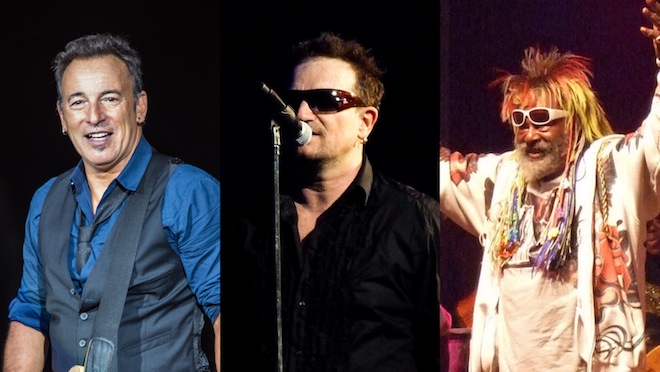
I asked Bruce Springsteen this question once. It was just Bruce and me, just me and him; so I asked Bruce the question. Sort of. I said, “My friend Bruce, what’s a great band all about?” He just looked at me and smiled.
“What’s music all about?” I asked him (This was in 2005 at the induction ceremony for U2 at the Rock and Roll Hall of Fame and Museum). And he said:
A great rock band searches for the same kind of combustible force that fueled the expansion of the universe after the Big Bang. You want the earth to shake and spit fire. You want the sky to split apart and for God to pour out…
I liked that answer very much, but I wanted to know more. So I went to Bono, and I said, “Bono, what’s music all about? I mean, what’s it really about?” Bono just stared out at all of the rock stars and hangers-on and journalists and fans at the Rock Hall as the great Bob Marley was about to be honored:
New hymns to a dancing god, redemption songs — a sexy revolution, where Jah is Jehovah on the street level — not over his people, but with his people…dressed to hustle God: ‘Let my people go,’ an ancient plea — prayers catching fire…
Now don’t get the wrong idea. These are not answers about religion even if there is a lot of Godtalk in them. But they are answers about soul. So in the spirit of the musical son who sort of knows how to ask a question, I turned to George Clinton. “What is soul?” I asked. “Soul is you, baby,” he said. And I thought, “Yes, that’s what we’re talking about. Music is going to lead us to the soul of the JCC Movement. Those songs are going to tell us all about us.”
Hold on tight. Here we go.
And add your song here.
shablogsong

Sunday, July 12, 2015

Sounding Board: I Have a New Gig I

There are things and then there are things. One of those things happens to be a new job. It's not that new -- about five months. As CEO and President of JCC Association -- the umbrella organization of the 350 sites that comprise the Jewish Community Center Movement -- every two weeks I have been posting a short piece on a song that inspires thinking about where this band of communities and opportunities might go. Find the originals at Sounding Board or, over the next few weeks, right here. The first is entitled: Let the Listening Tour Begin.
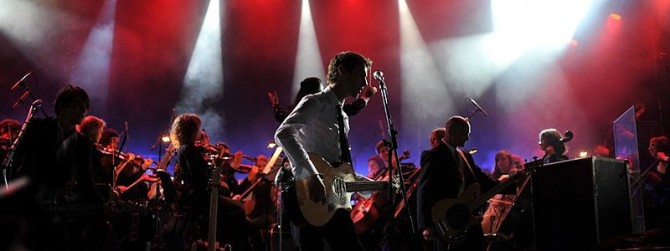
Patricia_band_during_the_Rock_Symphony_Concert_at_the_Potocky_Palace_in_Lviv_in_2011

You Get What You Give. Get Up Offa That Thing. You Cannot Win If You Do Not Play.
Melodies tripped and jangled through the New York City office of JCC Association during my first two weeks on the job as CEO and President.
You Better, You Better, You Bet.
After meeting individually with more than fifty members of our team in the first stage of an intensive assessment of our work with all of our stakeholders, I asked everyone for the song that she or he wanted to share with the family of three hundred and fifty JCCs and Ys, camps, and agencies we serve.
Friends. Power of Soul. I’ve Just Seen a Face.
Considering the millions of annual visits to our sites, the countless moments of meaning and connection and the endless possibilities JCCs offer each day — it’s no wonder our team wants to get up and sing about what we do.
What’s Going On? What’s So Funny ’bout Peace, Love and Understanding? Changes.
But we also recognize that as we enter a transition in leadership — with tremendous gratitude for what’s been built before us as well as a buzz of curiosity and determination to discover what’s next — there are many questions about what we as a movement should strive to be.
People. Natural Mystic. I Will Survive.
Music is one of the world’s great connectors — a comfort, a prophecy, a secret smile. It’s a looking glass to see ourselves and a window into the world. It’s the echo of what we think we know and a whisper of dreams we have all but forgotten.
Glory. Somewhere Over the Rainbow. Dream On. Yehiyeh Tov. New Day Rising.
Our team is listening closely: What rhythms will move our communities five, ten, or twenty years from now? What voices will blend in unexpected harmony? When you tune your ears to the sounds of the Jewish community of the future, what songs do you hear?
Listen to the #jccsoundingboard playlist here.

Tuesday, May 6, 2014

Leviticus: Keeping Holiness Simple

This article originally appeared on the Huffington Post. Read it here.
For centuries, formal Jewish study began not with Genesis, the first book of the Hebrew Bible, and not with the Mishna, the first codex of lived Jewish law, but with Leviticus, also known as Torat Kohanim, or the Book of Priests. While focusing in many sections, like last week's portion of Emor, on practices and obligations of the priestly class, Leviticus addresses all Israelites as a "nation of priests" whose relationship with holiness is nothing less than a matter of life and death.
Seeking holiness is the ethos of the Hebrew Bible from Adam and Eve on down. If wondering and worrying about holiness lives most vividly in Leviticus, then the heart of Leviticus is the "Holiness Code" (Lev 17-26) with which this week's Torah portion, Behar, concludes.

Holy Moses! This puts Beharin a pretty dramatic spot. How can any set of verses conclude a litany about holiness, which the Hebrew Bible claims is the essence of the meaning of life? Only by hitting us squarely in the places where so much of mundane life is lived and so much of holiness is lost and found. Behar wants to talk about our pocketbooks and our obsessions to show what it means to engage the ultimate truths that holiness holds.
What's in Your Wallet?
The answer to the question "What's in your wallet?" in ancient days was quite different than the answer to the same question today. For one thing, the answer in biblical times was almost universally "nothing" because subsistence was the name of the game. We might know stories about the wealth of the pharaohs or King Solomon or the occasional tribal fat cat, but for the 99 percent who were not royals, chieftains or members of the priestly class stationed at the top tier of Temple life, life was a hand-to-mouth struggle.
The economy of Leviticus revolves around animals, land and slaves, not money. But the irony of comparing issues of wealth or poverty then to now -- and perhaps one of the most powerful reflections on the human condition that one could ask to learn from an ancient text -- is that the economic challenge to pursuing holiness remains the same: When it comes to seeking holiness, nothing requires more effort or more intense partnership between humans and a higher power than confronting the scourge of debt.
Our portion lays out clear rules about avoiding any kind of financial servitude, including prohibiting interest on loans (Lev 25:37), restricting service of indentured servants and laborers (Lev 25:40) and banning servitude of these types for the offspring of those stuck in it (Lev 25:41).
The most extreme form of debt is slavery, a fall into the red so deep that it offers no possibility for redeeming one's basic human station. Leviticus demands that all people have direct access to redemption from debt, which shackles people from moving towards holiness.
Redemption from debt is not limited to people. In fact, the land itself must be redeemed as well. Beharoutlines sabbatical years in every seventh year -- just like there is a Sabbath of rest every seventh day (Lev 25:1-7). Nothing can be planted in the sabbatical year and both people and animals can eat only what the untended land offers. (Check out some of the work the organization Hazon is doing as next year's sabbatical approaches -- yes, it remains a very live issue, particularly in the Land of Israel.) A Jubilee, the 50th year of each cycle of seven sets of seven years, serves as a complete societal reset, not only in terms of planting and eating, but also in terms of redistributing properties towards societal balance (Lev 25:8-12). In addition, the Jubilee is the year where all slaves are set free.

Imagine how radical this system for wiping out debt and harmonizing humans, animals and the land would be if implemented in full today. Take all of the debts you hold -- all of what is or is not in your wallet including credit cards, mortgages, student loans, payment plans to healthcare providers, and on and on. Now simply erase them. The same, of course, is true of whatever others owe you. It just disappears. Holy Moses indeed -- this is a radical program for holiness.
Obsession and Idolatry
When it comes to obsession in days of old, we can guess by the sheer number of prohibitions in the Hebrew Bible that people could find all kinds of way to busy themselves. But the ultimate term for an obsession leading people away from holiness is idolatry, which is the final word of Behar and the Holiness Code in Lev 26:1:
You shall not make for yourselves, or set up for yourselves carved images or pillars, or place figured stones in your land to worship upon, for I the LORD am your God.
It is possible to understand the Hebrew Bible's abhorrence of idolatry in many ways. Differentiation between Israelite religion and that of its neighbors; an honest to goodness divine judgment about what kinds of worship works and what kind doesn't; assertion of priestly power; or any number of mysteries too ancient to discover. It might make the most sense to understand the terror about idolatry as a broad definition of the worldly attentions that can distract, distort, or usurp pursuit of holiness.
The most famous idol ever is probably the golden calf, which some rabbinic legends hold was actually created out of the precious metals the Israelites had lifted out of Egypt. Melded by Aaron, Moses' brother and the first Israelite priest, the golden calf so disrupts the pursuit of holiness that Moses smashes the first set of Ten Commandments meant to make the pursuit of holiness real. It's no wonder Behar wanted to make the Israelites remember what and with whom they are dealing with at the close of the Holiness Code.
"Be Holy!" says Lev 19:2, read two weeks ago. In summarizing a primary biblical goal already expressed fully in just two words, Behar, which is the shortest Torah portion in Leviticus, keeps it simple: If you want to be holy, remember that you are no man's slave -- and that no man is your slave; nor is the land your slave; and remember too that all forms of wealth are of only transient value. Then, once the nitty gritty of debt and redemption has been reviewed, the Israelites are asked not to be distracted by obsessions that sway the senses as they go and seek and serve. Just like traditional study of the Hebrew Bible, this is the place -- codes and questions of holiness -- where the biblical journey begins.

Wednesday, April 17, 2013

Jewish Peoplehood and the Biblical Landscape

Recently my family and I were in Rome for thirty-six hours on our way to Jerusalem. As we approached the Coliseum – a first time visit for us all – the core text was obvious, Bob Dylan’s “When I Paint My Masterpiece:”

Oh, the streets of Rome are filled with rubble
Ancient footprints are everywhere
You can almost think that you’re seein’ double
On a cold, dark night on the Spanish Stairs…
Oh, the hours I’ve spent inside the Coliseum
Dodging lions and wastin’ time
Oh, those mighty kings of the jungle, I could hardly stand to see ’em
Yes, it sure has been a long, hard climb…

While I am rock and roll obsessive, my academic training is in classical rabbinic text and culture. This means I have a lot of rabbinic texts and contexts under my belt. The portfolio of rabbinic teachings and stories specific to experiencing Rome and its cultural influence through Jewish eyes is large, colorful, and memorable.

But while these stories may have outlined the cultural footsteps I humbly imagined walking in, musical references still filled my thoughts. Tom Waits came next:

No justice here, no liberty 
No reason, no blame
There's no cause to taint the sweetest taste of blood
And greetings from the nation
As we shake the hands of time
They're taking their ovations
The vultures stay behind
In the colosseum tonight 

And then there was Bruce Springsteen’s “Wrecking Ball,” a song premiered on the eve of the demolition of
the modern-day Coliseum of the Meadowlands, “where the blood is spilled, the arena's filled, and giants played their games.”

My job for nearly fifteen years has been leading Jewish communal institutions. A big part of that job is making Jewish texts useful to people for whom they are otherwise not immediately accessible or important. There are many good ways to do that. One of them is blending personal meaning derived in general culture with the voices of tradition.

My own experience of gleaning meaning – whether in Jerusalem or Rome or, on most days, somewhere in between – is that traditional texts and feelings of belonging to the Jewish enterprise are made stronger when intertwined with contemporary cultural voices and perspectives. This includes hearing Jewish meaning in the most unexpected places and ways. What is true of individual experience is true of experiencing Jewish   Peoplehood on a communal level as well. Another beloved musical voice has parsed this idea.

In 1992 Leonard Cohen discussed with the Jewish Book Review a line from his song “The Future.” Asked to explain the words “I’m the little Jew who wrote the Bible” Cohen said:

As I get older I feel less modest about taking these positions because I realize we are the ones who wrote the Bible and at our best we inhabit a biblical landscape, and this is where we should situate ourselves without apology. The biblical landscape is our urgent invitation and we have to be there. Otherwise, it’s really not worth saving or manifesting, or redeeming, or anything.

I have been thinking about this biblical landscape a great deal in context of Jewish communal work lately. Much of the conversation about Jewish peoplehood work is narrowed by being limited to the most obvious kinds of immersive Jewish experiences – Birthright Israel, day schools and residential camps, or membership in a synagogue. These points of connection and many others surely offer potential for deepening a
sense of Jewish belonging and mutual responsibility.

But there is also a kind of cultural pluralism that offers paths to Jewish meaning. These paths navigate old tensions between Jerusalem and Rome as well as personal and communal urges. For people already immersed in personal and communal meaning “doing in Rome as the Romans do” – experiencing and shaping meaning through popular music like me, for example – this means thickening the peoplehood experience through connecting Jewish identity with the power of general culture, not by finding ways to shed or replace it.

In “Dear Diary” Leonard Cohen praises his own journal – the murmurings of his own heart, his own personal Rome and Jerusalem – as a transcendent sacred text in and  of itself:

You are greater than the Bible
And the Conference of the Birds
And the Upanishads
All put together...
Dear Diary
I mean no disrespect
But you are more sublime
Than any Sacred Text
Sometimes just a list
Of my events
Is holier than the Bill of Rights
And more intense

The goal of a Jewish educator should not be to remain in the sublime, deeply personal experience Cohen describes, but to build upon it, recognizing that only by facilitating a community comprised of individuals of rich, meaningful experience will Jewish communities be compelling enough to want to join. 

Navigating peoplehood requires a multidimensional, pluralistic map to the biblical landscape – Cohen’s poetic parsing of peoplehood. This is the place where meaning and connection emerge as personal and communal, ancient and contemporary, and belong to both Rome and Jerusalem. In educational terms, creating a map for Jewish experience with this kind of color, depth, and resonance is akin to painting a masterpiece.

This piece appears in the Peoplehood Papers 10, available at http://jpeoplehood.org/publications/. My thanks to Shlomi Ravid for asking me to write it.

Sunday, August 21, 2011

Jews with Force. Jews with Appetite. Jews without Shame.

When we first moved to New York City at the end of 1999, one of my first acts in the New Old Country was to start reading the New York Times regularly -- on the subway, at the table with the morning coffee, and, of course, on weekends as part of ritual immersion in the Sunday edition.

This little fantasy of cozy city living died quickly. The smell and smudging of the newsprint on my fingers and the thick piles of paper in a corner of a small apartment turned me off. The Internet, even in dail-up days, opened up a new reading vista. But most important, I didn't like being a witness to so much even-keeled, clever, intelligent, settled opinion all at once. The headlines looked like wrong, bad medicine at first glance. Who needed to be fed that poison in tidy spoonfuls? Why read it at all?

Now I can peck away at the web and scavenge opinion and tone however my discretion and taste require. If I make it through an entire 750 word op-ed or news item without interrupting myself with something easier or elsewhere you could call me riveted. I still scan the NYT headlines each day -- along with Haaretz and Slate. I read whatever Paul Krugman shares because I assume he is always right and never followed and this offers an edge of exasperated underdoggedness to fuel other battles over the course of the day.

I pluck and pull from Arts and Culture or Business or Obituaries, and though I know many people do -- religiously -- read Roger Cohen, I don't recall ever having read one of his pieces until today.

Weary from too much espresso, I scanned the Times on-line and hit upon
"Jews in a Whisper."

I am in Israel right now for work and family reasons. It's good to be here. I have many, many friends and associates in Israel -- people of incredible talent and generosity who are some of my closest, most trusted peers. I am fluent in Hebrew. I have served in the Israeli Army. Many of my most cherished memories -- not to mention my own family -- took root here.

I arrived just as the tent cities protesting the exorbitant cost of living for average Israelis began sprouting up. I had read of their emergence with excitement and pride and was moved to have seen them in some form in all of the cities I have visited or worked in thus far on my trip -- from Or Akiva and Zichron Yaakov to Jerusalem, Herziliya, and Tel Aviv.

So today, immersed as I am in the messy day-to-day of a Jewish state deeply misguided by its mostly mediocre and dangerous leaders, watching missiles over head in the south and listening to terrorist warnings in Jerusalem and paying $7 for a half gallon of milk, I found Mr. Cohen citing Philip Roth.

Having called upon Mr. Roth many times in my own work, I am sympathetic to the idea of appealing to his voice to amplify a longing or a critique of Jewish purpose and practice.

“Jews with force, I’m talking about. Jews with appetite. Jews without shame,” quotes Mr. Cohen of Mr. Roth, citing a scene concerning what Roth himself longs for as a Jew when living in the UK.

"I miss them, too," says Mr. Cohen, concluding his piece about the State of the Jews today.

I am not an apologist, I protest, even as I protest too much. But I will say it anyway: While I share Mr. Cohen's distress with the State of the Jews (a primary part of my day job, and also my academic, creative, and family life), my concern is concentrated mostly on those who hold formal power in the Jewish realm, particularly in Israel. A severe lack of strength lies in the realm of leadership and the corrupted, comprised, corroded, and convoluted systems upon which it depends.

In the places where real people live and strive, I see strong Jews every day. They are in those tents in Israel, many of them loudly and correctly explaining that their causes and the causes of peace with all of their neighbors are tangled together as thickly as the bands of an ancient olive tree. They volunteer, they break ranks with the status quo, they teach, they disappear into religion, they try to make the best out of the status quo, they walk away, they get spit out, they cut me off in traffic, they wait.

It's hard for people engaged in the science of opinion to express what an artist can share over the many pages of a book or the acts of a play or the verses of a song. There's nothing new in that fact, especially when it comes to expressing generative thought on religion.

Beginning in 1923, Sigmund Freud corresponded with Romain Rolland, a French novelist challenging that Freud's writings on religion had missed the point entirely. Rolland claimed that a proper theory of religiosity must describe the essential "oceanic feeling" of emotional and spiritual connectedness within which a person of religious temperament experiences life. Writing with admiration if not full recognition for Rolland's challenge in Civilization and Its Discontents, Freud says: "I cannot discover this oceanic feeling in myself. It is not easy to deal scientifically with feelings."

Philip Roth has helped me construct huge swaths of my own religious landscape, but even in his brilliance as a Jewish commentator, as a Jewish communal leader, he has essentially opted out. Asked about Jewish identity once by a reporter for The Guardian on December 14, 2005, he said: "It's not a question that interests me. I know exactly what it means to be Jewish, and it's really not interesting."

But it can be very interesting. The work still to be done -- and that is being done - is as deep and as wide as the ocean.

Wednesday, July 20, 2011

Reimagining Our Communal Infrastructures: The Gardens Where Innovation Should Grow

Despite its challenges, Jewish communal life remains an ecosystem of tremendous size and equity. I agree with my colleagues that the innovation ecosystem must strive for better business models and that the funding streams within this system should flow more generously. Yet, of all the efforts that might be undertaken to support a loosely affiliated network of innovative, culture changing organizations without whom Jewish communal culture lacks relevance, color, and depth, perhaps the most critical is converting the vast terrain of the Jewish infrastructure into a garden where they can grow. New Jewish Culture should be the force transforming the essence of the infrastructure we have already built.

Friday, July 15, 2011

On Reenchanting the Jewish Communal Infrastructure

I like what Ariel Beery, Nina Bruder, Sarah Kass, and others are saying about JDub's wind-down as a call to action. The Jewish communal infrastructure - like all social structures - continually faces the threat of stasis. JDub's crisis embodies this challenge.

Max Weber warned us that this would happen. More than a century ago the German sociologist explained that the covenantal, salvation religions Judaism, Christianity, and Islam – systems that have defined the societies of much of the world and all of the West for more than 1500 years – exist within the tension of two competing energies.

On one side of Weber's scale of religion rests charisma, or, perhaps "innovation" in contemporary terms. Charisma manifests itself through religious sensibilities igniting prophecy, spreading magic, and untethering inspiration. At the scale's opposite end perches rationality, an urge for the lasting structures that societies generate to regulate, systematize, and mediate charismatic energy. Properly functioning religious systems and the societies based upon them facilitate movement on the scale between the opposite poles of charisma and rationalization.

According to Weber, ideal religious systems are inherently in flux. Charisma is temporary, its results unpredictable. Rational religious structures, though they seek stability, thrive by remaining open to a dynamic relationship amidst the spirals of the spirit.

When charisma and rationality become static and unbalanced for an extended period of time, religious structures produce insidious forms of entropy and oppression ranging from boredom and lack of meaning in the experience of everyday life to societies trapped in authoritarian violence.

While Weber anticipates the vacuum of communal stasis, he also suggests the possibility of openings for religious figures and movements that might eventually emerge to salvage sensibilities of magic and depth from fossilized covenants:

No one knows who will live in this cage in the future, or whether at the end of this tremendous development entirely new prophets will arise, or there will be a great rebirth of old ideas and ideals… (Max Weber, The Protestant Ethic and the Spirit of Capitalism, 1904)

In days ahead on www.jta.org, Steven M. Cohen and I will share an opinion piece on why - without a coherent Jewish cultural policy to develop, implement, and sustain innovation - our infrasture faces stasis. The good news is that organizations like JDub have shown us how much talent and innovation is available to address our imbalance if we can find means and courage to sustain them.